
Maryville Treatment Center Releases
A person leaving Maryville Treatment Center may enter the community on parole or conditional release. Parole follows a Missouri Parole Board order, while conditional release divides part of a sentence into supervised community time under state law. In both cases, physical confinement may end while MODOC legal custody and field supervision continue. A field-office assignment is evidence of a community supervision setting, not final discharge.
Another person may transfer to a different MODOC institution. That movement ends the MTC placement but not incarceration. A parole hearing also is not a release, and a Board decision that sets a future date does not prove the person has left. Finally discharged people are no longer included in Missouri's active public offender search, so an empty current result requires a historical data or Sunshine-record check rather than a guess.
| MTC event | Custody meaning | Primary record path |
|---|---|---|
| Institution transfer | State incarceration continues | Active MODOC assignment and caseworker |
| Parole | Community placement under DOC legal custody | Active field record and Parole Board order |
| Conditional release | Supervised portion of the sentence | MODOC and Probation and Parole |
| Final discharge | Active DOC relationship ends | Historical FAK930 or Sunshine record |
Note: Leaving Maryville Treatment Center may start field supervision, so physical release and final discharge must be checked separately.
Confirm an MTC Release
The statewide MODOC Offender Search is the correct public starting point. It covers active incarcerated people, probationers, and parolees. It expressly excludes discharged offenders. That scope explains why a positive result can remain after someone leaves prison and why a negative result cannot, by itself, prove final discharge.
Follow these steps for a Maryville Treatment Center release:
- Search the active portal by first and last name, including known aliases, and complete its CAPTCHA.
- Match identity cautiously, then read whether the assigned place reflects an institution or a field-supervision setting.
- Ask the institutional caseworker or parole office about a person-specific physical release or home plan when disclosure is permitted.
- Use the historical MODOC file or request a discharge record if the active search has no matching person.
- Review Case.net and Parole Board records for the court sentence and release authority.
The broader Nodaway County released-inmate lookup identifies which source answers each custody question.
MTC Active Offender Search
The live MODOC portal is designed for active cases. An institutional assignment indicates a prison placement. A field assignment generally points to active community supervision. Neither label alone gives the moment a person walked out of Maryville Treatment Center, and neither supplies a county-jail release. The named caseworker, field officer, or institutional parole office is the person-specific route when a current placement needs clarification.
The official search welcome screen states the active-only scope and permits name and alias searching.
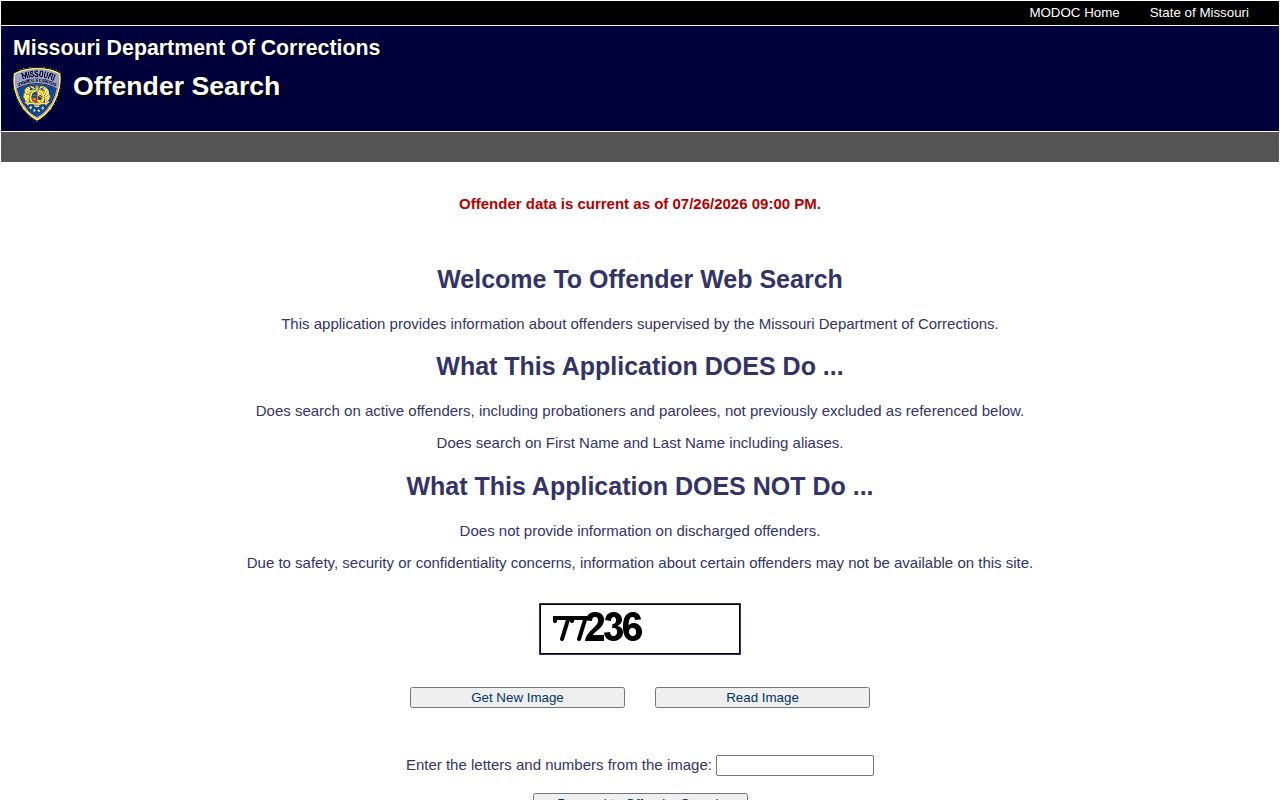
The screenshot supports those search limits. It should not be used to promise an unverified live-profile photo or a field labeled “projected release date.”
An active field record may describe a person already living in the community. A discharged person may disappear from this search entirely.
MTC Discharge Record Search
MODOC's Sunshine Law and data page provides a nightly FAK930 file for people who are or have been under DOC supervision, with records reaching as early as 1974. The file can contain multiple charge records for one person. Useful fields include DOC ID, name, birth date, assigned place, institution-or-field flag, court cause number, sentence county, offense description, and Completed Flag.
A Completed Flag of Y means the sentence record is completed. The file does not document a separate actual exit timestamp or release reason, and it contains no photo field. A precise Maryville Treatment Center discharge or status record can be requested from OD.SunshineRequest@doc.mo.gov. Include the DOC number, full name, birth date, court case, and exact record sought. Parole Board records use ParoleBoard.SunshineRequest@doc.mo.gov.
Note: The historical file locates sentence data, but a targeted MODOC record is stronger evidence of an exact discharge.
MTC Release Date Meanings
The official historical layout uses two exact labels. Sentence-I Minimum Release Date, coded $PC, is the calculated minimum release date for the active sentence. Sentence Maximum Release Date, coded $PD, is the maximum release or expiration date for that sentence. Special values represent life, indeterminate or interstate cases, and field assessment or investigation. These are sentence-data fields, not a certified physical exit time.
- Minimum release date
- A calculated sentence date that does not promise release on that day.
- Maximum release date
- The maximum or expiration date for the sentence record, which may differ from the institutional departure date.
- Parole
- Community release under Board authority while DOC legal custody continues.
- Discharge
- Completion of the active sentence or supervision relationship documented by the responsible agency.
Missouri's dangerous-felony 85-percent minimum in section 558.019 does not apply to everyone and does not guarantee a date. Parole guidelines also are not commitments. Conduct, programming, sentence structure, detainers, court changes, and Board action may alter timing.
Release Is Not Discharge
The Missouri Parole Board may set a future release date or schedule another hearing. Its guidelines are advisory, and a hearing is only a review opportunity. Official material says decisions ordinarily take about eight to twelve weeks. No public monthly hearing calendar or person-searchable decisions database was found, so no unrelated calendar should be treated as an MTC release list.
Section 217.690 clarifies that parole is not clemency, a pardon, or a sentence reduction. A person released on parole stays in DOC legal custody and must comply with supervision. Conditional release is also supervised. Final discharge is a later legal status. MOVANS or VINELink notifications may report a custody event from a participating source, but the institutional and Board records remain the precise confirmation route.
MTC Release to District 1S
Someone approved to live in Nodaway County may move from institutional parole planning to a local field assignment. The MODOC directory lists District 1S-Maryville at 115 E. Fourth Street, Maryville, with telephone 660-582-4799. Office staff can route appropriate supervision questions, though confidential case details may not be public.
An assigned field office means community supervision. It does not mean the sentence has been fully discharged. The court docket, active MODOC record, field office, and Board order may each document a different part of that status. Earned compliance credit under section 217.703 reduces eligible supervision terms after compliant months; it is not universal prison good time and does not rewrite the actual date someone left MTC.
Note: District 1S can route supervision questions, but the assigned office may withhold confidential person-specific details.
MTC Release Records by Question
A single database does not answer every Maryville Treatment Center release question. The active MODOC search answers whether the person remains in an active institution or field-supervision case. The FAK930 history supplies durable sentence and assignment fields after final discharge. A person-specific MODOC status or discharge record is stronger when the precise legal end of supervision matters. The Parole Board record identifies the authority and conditions behind a parole decision.
Case.net documents the judgment, sentence structure, later court orders, and revocation activity. VINELink can send a participating-agency custody notification, but its event is not a permanent institutional release certificate. The public sex-offender registry may contain a release or supervision-placement date only for a person who is legally required to register. That narrow registry cannot be used as a general MTC release list.
Match the record to the question. Ask the facility or caseworker about physical movement and a current home plan. Ask the field office about a public confirmation of supervision. Ask MODOC or the Board for the historical status, decision, or discharge document. Compare sentence dates with the court record instead of reading a minimum, maximum, hearing, or guideline date as proof that release already occurred.
Maryville Treatment Center Contact
Maryville Treatment Center is a MODOC institution. Its staff, caseworker, or institutional parole office is the appropriate route for an authorized person-specific question about an anticipated physical release, transfer, or home plan. General historical record requests go through MODOC rather than the Nodaway County Sheriff.
Maryville Treatment Center30227 U.S. Highway 136
Maryville, MO 64468
Phone: 660-582-6542
Fax: 660-582-8071
Operator: Missouri Department of Corrections
The official MTC facility listing confirms the location, phone, and minimum-security classification.
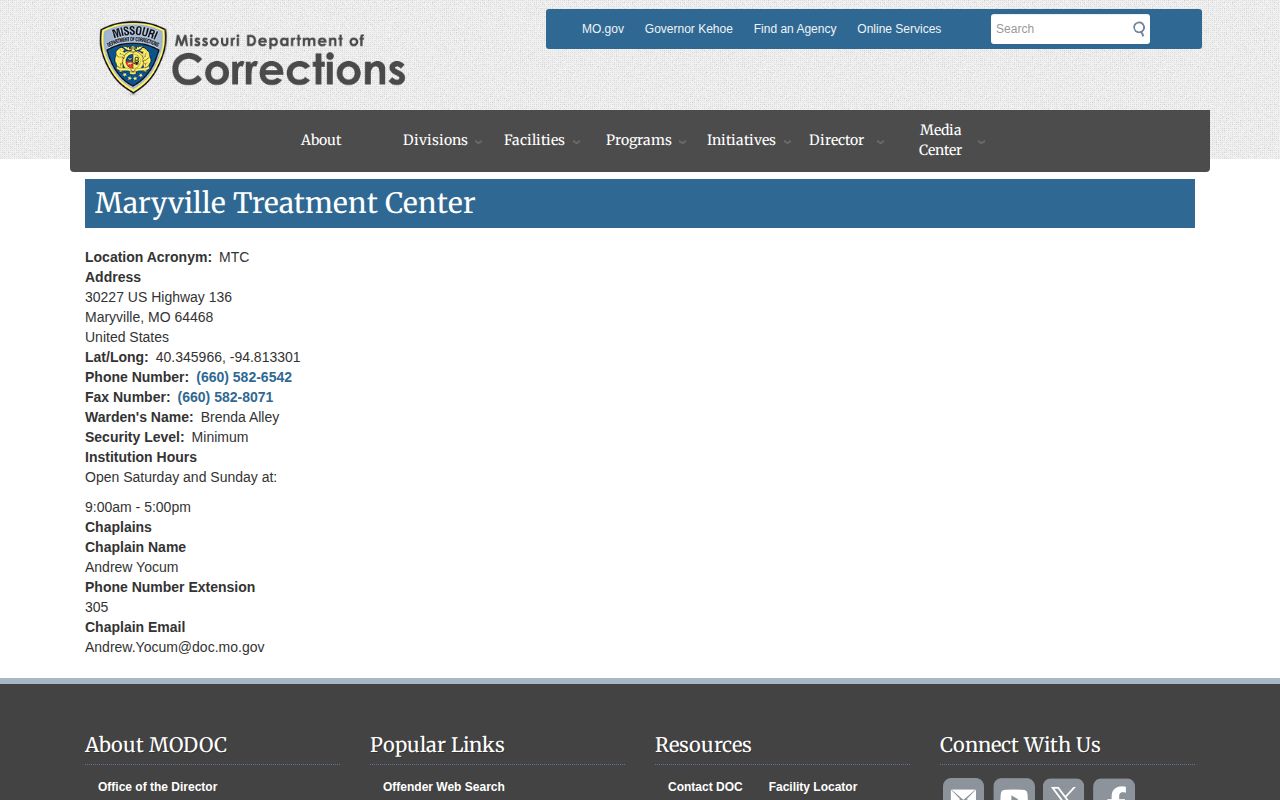
That source identifies the state institution and should not be confused with the downtown county jail or its current-inmate page.
How MTC Became a Prison
MODOC reports that Maryville Treatment Center occupies a state-owned site of about 39 acres. The buildings were created in 1948 as a Sisters of St. Francis convent, and the property became a treatment center in 1995. The current program page describes a 525-bed male minimum-security institution with intermediate, long-term, and OUT program types.
This history reinforces the custody boundary. MTC is a state treatment institution with statewide DOC records. It is not an annex of the Nodaway County Jail, and its releases do not appear on the Sheriff's manually maintained roster. The facility type determines the correct search, record custodian, and meaning of release.